Requisitionists
How a petition to Parliament was actually got up — who signed the requisition, who called the meeting, where the paper lay for signature, and who carried it into the House. Read out of the newspaper adverts and reports in this archive, with the statutes that governed every step.
Requisitionists
Until late in the nineteenth century a petition to Parliament was rarely a private act. It was the end of a public process, and the process started with a piece of paper. A requisition was a short address to the chief officer of a place — the mayor, the bailiff, the high constable — asking him to convene the inhabitants. The people who signed it were the requisitionists. Once enough hands were on it, the officer had little choice but to name a day, an hour and a place, and the machinery followed from there: the meeting, the resolutions, the petition drawn, the places where it lay open, and a Member to present it.
It is critical to note from the outset what this elaborate apparatus did not apply to. Single individual petitioners and small bodies of 5 or 10 people were totally privileged and exempt from all these regulations. Under ancient constitutional right and the Bill of Rights 1689, any subject could frame a personal petition for redress of grievance without needing a requisition, without advertising in newspapers, and without seeking a magistrate's permission. The entire formidable machinery detailed below existed solely to control, restrict, and suppress mass collective assemblies of the unrepresented.
Where the officer refused, the requisitionists might go ahead on their own authority — which is precisely the conduct the statutes of 1795 and 1817 were built to reach.
The requisitionists, in consequence, called a meeting on their own authority—and at that meeting agreed to this petition. Hansard, House of Commons, 1 February 1821 — debate on a petition hansard.parliament.uk
The normal, orderly course is best shown by the archive itself. In May 1832, at the height of the Reform crisis, the inhabitants of Newcastle got up a meeting in a matter of hours:
The six steps of getting up a petition
-
Someone draws the requisition
A short paper naming the purpose of the meeting and asking the chief officer to call it. It circulates for signature — in streets, shops and inns — and the names on it are what give the meeting its standing. The Newcastle requisition took “an hour or two” to be “very numerously and most respectably signed”; the wording of the purpose was drafted into the requisition itself, so that no one could later say what the meeting was for.
-
The officer fixes the meeting, and someone takes the chair
The mayor, bailiff or magistrate names the day and place, and the meeting is opened with a chairman — usually a local gentleman or magistrate — who takes the sense of the room. This is the point at which the statutes bit: after 1817 a meeting of more than fifty persons to deliberate on a grievance was unlawful unless properly called and noticed, and after 1819 it could not be held at all within a mile of Westminster Hall.
Specimen — called by the magistrates, chaired by a JP “The meeting was called by the magistrates and chaired by a local Justice of the Peace.” The people of South Shields, 31 December 1830 · The National Archives, catalogue ref. HO 44/24 · Great Reform Act — Source One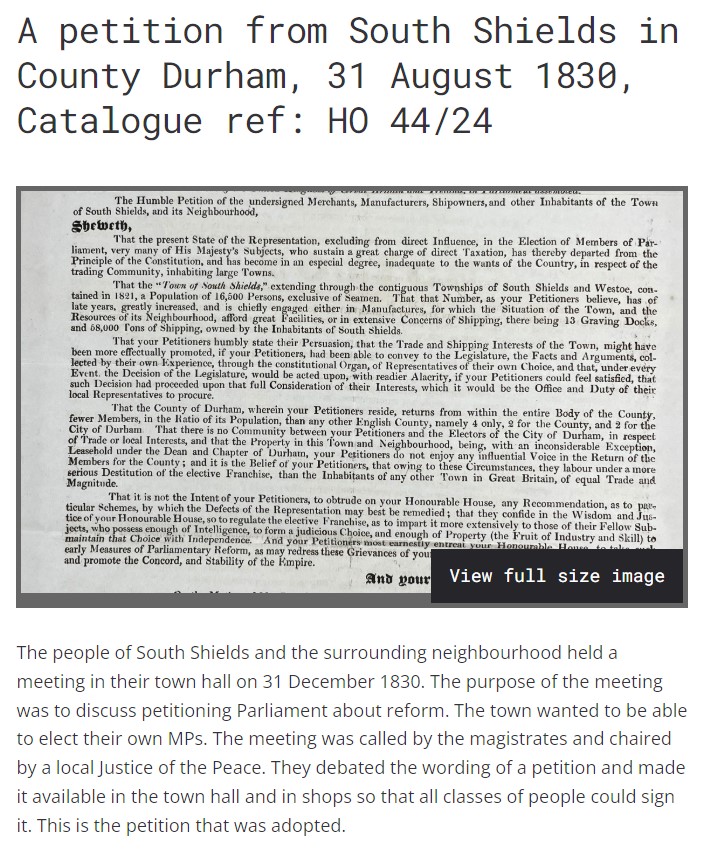
-
The petition is framed and agreed
The wording is debated in the room, then adopted; resolutions are passed; and a committee is appointed to carry the business on and to cheaply multiply the effort in neighbouring places. A Herefordshire meeting of butchers and tanners in 1801 moved:
Specimen — three resolutions “That a humble Petition to Parliament be prepared and signed”… “That Committees be appointed in other places for the same purpose”… “That Books of Subscription be opened”. Meeting on the Act against the use of raw hides, Herefordshire, 1801 · archive item 1801 meeting of craftsmen for petition.txt · badly degraded OCR; resolutions quoted only where legible -
The petition lies for signature
This is the step the archive documents best, because it had to be advertised. The adopted petition was left open at named places — taverns, coffee houses, booksellers, the Royal Exchange, a solicitor's office — and the public were told where, and for how long. Sometimes for one day only. Sometimes with a line added that “copies of the petition may be had on application”, so that a reader could take the wording away and gather signatures of their own. This is the direct ancestor of the modern petition sheet, and it is why the adverts are the evidence: the notice was the procedure.
Specimen — the places named “…PETITIONS to Parliament, praying for the ABOLITION of SMITHFIELD as a LIVE CATTLE MARKET, LIE for SIGNATURE at the following places:—At the London Tavern, Bishopsgate-street; the Crown and Anchor, Strand; the British Coffee House, Cockspur-street; the Exchequer Coffee House, Palace-yard, Westminster; and at the Offices of Henry F. Richardson, Esq., Solicitor…” Morning Herald (London), January 1847 · archive item 1847 abolition of live cattle market lies for signatures.txt -
It is carried to Westminster — through a Member
No private person could walk a petition into the Commons. It had to go in through a Member, and the Member could decline. That rule, argued out in the courts as late as 1909, is where the archives of procedure and the history of the franchise meet:
Specimen — the constitutional rule “There is no constitutional right to compel a Member to present a petition, but there is a constitutional right to present petition.” — Mr. Muskett: “But all petitions must be presented to the House through a Member.” Reported argument, High Court, printed in Votes for Women, 16 July 1909 · archive item F Votes for Women - Friday 16 July 1909.txtThe 10-person presentation privilege: While mass crowds were barred from marching to Parliament, the law expressly protected small deputations. Under the Tumultuous Petitioning Act 1661, a delegation of no more than ten persons was legally privileged to present a petition directly at Westminster. Solitary petitioners or small delegations of 5 or 10 citizens had the unfettered liberty to carry their parchment to the House without committing any statutory offence. -
The law stood over all of it
From 1661 the manner of procuring signatures was itself an offence; from 1795 and again from 1817 the meeting that produced the petition was regulated down to the number of days' notice, the number of signatories and the lodgement of a copy with a justice of the peace. The statutes are set out below.
The law that governed the getting-up
- 1661 — Tumultuous Petitioning Act (13 Chas. 2 st. 1 c. 5) The Act that made the manner of getting signatures criminal. Its preamble is quoted in a criminal-law volume preserved in this archive: “it hath been found by sad experience that tumultuous and other disorderly soliciting and procuring of hands for petitions on political matters have been a great means of the late unhappy wars.” It made it an offence to procure more than twenty signatures without official assent. Yet it explicitly established the privilege for small numbers: it prohibited approaching the King or Parliament accompanied “above the number of ten persons”—meaning a solitary individual or a delegation of 5 or 10 persons remained completely lawful, privileged, and exempt from criminal penalties. Text: legislation.gov.uk — 13 Cha. 2 st. 1 c. 5 · quoted in archive item A HISTORY OF CRIMINAL LAW IN ENGLAND vol2.txt
- 1714 — Riot Act (1 Geo. 1 st. 2 c. 5) Aimed at unlawful, riotous and tumultuous assemblies of twelve or more: the magistrate reads the proclamation, and any who do not disperse within the hour are guilty of felony. A printed copy of the Act survives in this archive, set out with the proclamation wording. Archive item ADVERTS/1714 b.txt
- 1795 — Seditious Meetings Act (36 Geo. 3 c. 8) Part of the “Two Acts”, passed in December 1795. It restricted public meetings of more than fifty persons and required a magistrate's licence for lecturing and debating halls where admission was charged and policy discussed. Small bodies, private associations, and individual petitioners lay entirely outside its reach. A Hereford newspaper in this archive carries the Lords' debate on its second reading. Text: statutes.org.uk — 1795 Seditious Assemblies Act · Wikipedia
- 1817 — Seditious Meetings Act (57 Geo. 3 c. 19) Royal assent 31 March 1817. A meeting of more than fifty people called to deliberate upon any grievance became unlawful unless summoned by an authorised official or properly noticed. Organisers had to act at least five days beforehand, either advertising the time, place and purpose in a newspaper or lodging a notice with the clerk of the peace; the advert or notice had to be signed by seven local persons, with a copy sent to a justice of the peace, who could attend and disperse the meeting. Once again, smaller bodies of petitioners were untouched by these constraints. Wikipedia — Seditious Meetings Act 1817
- 1819 — Seditious Meetings Act (60 Geo. 3 & 1 Geo. 4 c. 6) Passed with the other “Six Acts” after Peterloo. It tightened 1817 for meetings of more than fifty: six days' notice of any meeting, given to a magistrate and signed by at least seven householders, with meetings confined in effect to parish level — and it banned public meetings within a mile of the gates of Westminster Hall, in the shadow of the House itself. Wikipedia — Seditious Meetings Act 1819 · statutes.org.uk — 1819 Act
When examining the harsh web of legislation above, it is vital to recognise who was not caught in it. Single individual petitioners and small delegations of five or ten citizens were entirely privileged and exempt:
- The 50-Person Statutory Threshold: The Seditious Meetings Acts of 1795, 1817, and 1819 were strictly triggered only when more than fifty persons assembled. A small body of 5, 10, or 20 people meeting in a parlour, coffee-house, or committee room did not need seven householder requisitions, did not need five-day newspaper notices, and was free from magistrate licensing.
- The 10-Person Statutory Westminster Safe Harbour: The Tumultuous Petitioning Act 1661 specifically codified that a petition could be presented to the King or Parliament by an individual or a delegation of not more than ten persons. Small deputations could walk directly to Parliament without fear of arrest.
- Unfettered Individual Right: A single subject petitioning for redress of personal or local grievances exercised an absolute constitutional right under the Bill of Rights 1689. They required no public meetings, no adverts, and no official sanction.
The state did not fear the petition as a literary or legal instrument; the ruling elite feared the mass meeting. Every statutory fetter — the requisitions, the five-day newspaper notices, the seven householder signatures, and the dispersal powers of the magistrate — was designed solely to suffocate collective public assembly. For the single petitioner and the small select deputation, the avenue to Parliament remained wholly privileged and unobstructed.
The adverts — where the procedure is visible
Every advert below is a step of procedure printed and paid for: the petition is named, the purpose is stated, and the place of signature is given. Together they map the ordinary venues of political business — a tavern, a coffee house, a bookseller, a solicitor's office, a committee room.
The signature places named across the adverts are worth reading as a list, because they are the geography of how a nineteenth-century petition was actually signed:
- The London Tavern, Bishopsgate-street
- The Crown and Anchor, Strand
- The British Coffee House, Cockspur-street
- The Exchequer Coffee House, Palace-yard
- The British College of Health, New Road
- The Hygeist Office, 363 Strand
- Mr. Field, Bookseller, 65 Quadrant
- Mr. Chappell, 84 Lombard Street, City
- The Royal Exchange
- Commercial Sale Rooms
- A solicitor's office, Coleman-street
- A shareholders' committee-room, Lothbury
Reading the notices
An advert of this kind carries its own procedure on its face. Read against this checklist, the presence or absence of each element is itself evidence of what was required — and of when.
- What the petition asks for, stated plainly
- Which House, or both Houses
- Who it comes from — inhabitants, subscribers, bondholders
- Where the paper lies for signature
- How long it lies — a day only, or until further notice
- Whether copies may be had on application
- A named officer, secretary or solicitor to act for it
- Wording that echoes the statute — “Notice is hereby given”
Sources
The framework, from outside the archive
- The National Archives — “What caused the 1832 Great Reform Act?”, Source One — the South Shields petition of 1830 (catalogue ref. HO 44/24) and the meeting that produced it.
- statutes.org.uk — 1795 Seditious Assemblies Act (36 Geo. 3 c. 8).
- Wikipedia — Seditious Meetings Act 1817 (57 Geo. 3 c. 19).
- Wikipedia — Seditious Meetings Act 1819 (60 Geo. 3 & 1 Geo. 4 c. 6), with the text at statutes.org.uk.
- legislation.gov.uk — Tumultuous Petitioning Act 1661 (13 Cha. 2 st. 1 c. 5).
- Hansard, House of Commons, 1 February 1821 — the requisitionists and their petition.
- The Victorian Web — the Six Acts 1819.
From the archive itself
- STORIES OR OTHER/The_Times_1832_05_17_Page_6.txt — the Newcastle requisition to the chief magistrate, 1832.
- 1801 meeting of craftsmen for petition.txt — Herefordshire meeting, resolutions, committees and subscription books.
- 1847 abolition of live cattle market lies for signatures.txt — Smithfield petition lying for signature.
- 1847 dangerous chemicals PETITION.txt and 1847 poisonings.txt — the people's petition against poison sales.
- 1846 great railway.txt — petitions to both Houses, one day only.
- 1851 lying for signature petition.txt — Chelmsford petitions to both Houses.
- dock moniopoly 1855.txt — the London dock companies.
- Westminster Improvement lying for signature 1856.txt — the fullest specimen of the form.
- A HISTORY OF CRIMINAL LAW IN ENGLAND vol2.txt and A Stephen Hist. Crim Law Eng.(Vol 2).txt — the 1661 Act, its preamble and its survival.
- ADVERTS/1714 b.txt — the Riot Act 1714 printed with the proclamation.
- F Votes for Women - Friday 16 July 1909.txt (with A–D of the same date) — the right to petition, and presentation through a Member.